Community: What Is It Good For?
This year, ATypI held its first conference in the Middle East and North Africa at the University of the Arts Sharjah. An innocently-intentioned TypeDrawers thread titled “ATypI 2026 Sharjah: who is going” eventually spent its length targeting Alexandra Korolkova, ParaType's art director and a 5% co-owner, who was on the programme.
The company's record was older. In 2016, Monotype cited US sanctions and refused to license Times New Roman to RusBitTech, the developer of Astra Linux. ParaType created the replacements, PT Astra Sans and PT Astra Serif; Korolkova was one of the designers. Astra Linux Special Edition is FSB-certified to process state secrets. In late September 2022, after the referendums Russia held in the occupied Ukrainian territories, ParaType's director, Anna Yakupova, wrote in a designers' Telegram chat that is now closed: “The results are obvious. Welcome home, to Russia.” The post survives as screenshots. ParaType said the words were “out of context” and that the team was “united by the love for typography, not by political views.”
The complaint is narrow: it concerns a professional record and a 5% stake. It does not claim that Korolkova was personally contracted by the FSB or the Ministry of Defence, or that she endorsed Yakupova's statement. Yakupova answers in the thread: her opinion is her own, she says, and her colleagues should not be involved. The demand for a disavowal runs into a structural bind: a company inside a state is being asked to denounce the state that licenses it. No Russian company can do that and remain one. Punishment came anyway; Fonts In Use stopped linking to ParaType's website.
This September, an open letter with more than 300 signatures asked the board to review or suspend Korolkova's participation pending an ethical review, give her a right of reply, and issue a reasoned written outcome by 25 September. It cited ATypI's Code of Conduct, the president's statement at Stanford that type is not neutral, and the June attack that damaged the Kyiv Pechersk Lavra, where one of the letter's authors works. Two Ukrainian speakers withdrew. On 19 September the board replied privately, declared the matter resolved, and kept Korolkova on the programme. No public reasoning followed. Both the Ukrainian designers' demands and ParaType's silence come from the same state violence: one answers it, the other is trapped inside it.
A post about the host state ended “boycott? naaaa.” In the UAE, same-sex activity is criminalised, with codified penalties up to fourteen years and a possible death penalty under Sharia, though the Human Dignity Trust finds no evidence that it has been used. Independent unions are banned, and there is no right to organise, bargain, or strike. About ninety percent of the workforce is migrant, tied to employers under kafala. The post made the observation and then dismissed it.
That asymmetry of interest is the subject. The community mobilised against a speaker it could remove, but not against a venue it required. John Hudson, a former ATypI vice president, said ATypI was “proceeding with providing institutional cover and a platform to one of the principals of ParaType”. He would not attend. The mobilisation was real, and it also reached its limit. But political alignments, and whose tragedy weighs more, are not very helpful to question. Capacity, meaning what the association can actually refuse, is what counts.
ATypI was founded in 1957 by Charles Peignot to bring type manufacturers together and to get typefaces into the rules protecting industrial design. Type historian Dan Reynolds describes it as a redo of the Verein der Schriftgießereien, with foundries from several European countries and a French name. By ATypI's own account, in the early 1990s, as the proprietary manufacturers' market collapsed and PostScript fonts took over, the organisation redefined its mission as a professional body. It lost its owners' market, not a worker-led past, and recruited the workers as members. Its Moral Code for manufacturers was abandoned in 2004.
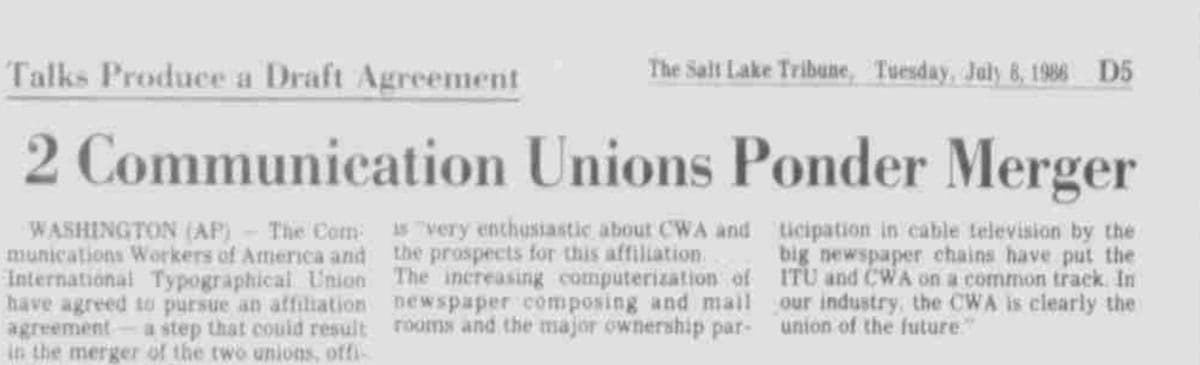
Some historical cases are blunter. The Verein Deutscher Schriftgießereien was founded in 1903, the year of the typefounders' strikes. In 1905 it adopted the Normal-Schriftlinie, a common measure that made undercutting visible. Reynolds reads the organisation as formed mostly to keep prices high and coordinate responses to union demands. It signed collective agreements in 1926, issued a tariff in 1932, and dissolved in 1971. Real worker-led bodies were unions with treasuries and strike leverage. The International Typographical Union, a North American union, counted 120,000 members at its peak, securing wage floors for over a century and a pension from 1908, before phototypesetting and digital composition dismantled its craft base. The union merged into the Communications Workers of America in 1987. The professional associations that survived did so because they were never worker-led.
In 1950, C.L.R. James, writing with Raya Dunayevskaya and Grace Lee Boggs, gave this mechanism its coldest sentence: “By a remorseless logic, therefore, representation of the proletariat turns into its opposite, administration over the proletariat.” He was analysing Soviet labour bureaucracy, but the analysis fits any body that manages its constituency rather than building shared power. It substitutes symbolic gestures for material ownership: a committee seat, an advisory role. It claims to speak for the whole industry, workers included, while using those workers as the raw material for its ends: sponsorship, longevity, and the standing of those at the helm.
In return, the association produces legitimacy. It convenes, awards, and distributes the prestige that lets a field recognise itself. What it cannot produce is a bargain. The Graphic Artists Guild, founded in 1967, publishes the Handbook: Pricing & Ethical Guidelines, now in its seventeenth edition. It is not a union, and the handbook carries no sanction. Nice to have.
The conference is where the form is most material. Someone pays for the room, the travel, the access. The balance sheet becomes a constitution: it sets the limits of what the body can say. A membership body answers to its members, not to an open letter, however many signatures it carries. And any public reasoning would have had to name grounds that split a membership holding both sides of a war. That silence is what universality costs.
Craft and identity serve as spackle, severing the finished letterform from the conditions of its production. A typeface made within a warring state shares a programme with presidential rhetoric on non-neutral design. Neutrality is selective, and identity serves as its alibi: ATypI programmed an “African Night” in Sharjah, part of a state that SWISSAID documents as a global hub for conflict gold.
The trade press mirrors this circuit, sustained by the studios, schools, and foundries it profiles. Labour conditions generate no ad revenue. Instead, coverage cycles through soft topics: craft revivals, whether designers should code, or inclusivity panels hosted in countries with restrictive visa regimes.
Inclusivity without a fee floor lowers production costs. Every designer added to an unprotected market expands supply and depresses prices, subsidising corporate buyers who frequently sponsor the events. This is also the organised cartel's argument: restricting entry protects the incumbents. A union sets a floor for workers and can strike or limit production; a cartel sets one for owners and boycotts undercutters. Type design has no union.
The market has two ends. The bottom is elastic.
The top stays scarce because the institutions the associations support fix their selling prices while what they buy—design labour and intellectual property rights—gets cheaper as the field grows.
Without the associations to protect their interests, the top would fall too.
A second mechanism runs through revenue. An association funded by sponsors, fees, and a broad membership cannot afford conflict. The wider the tent, the less the conversation can name. The first question for any of these bodies is not who joins but who pays. When an association speaks past its revenue, its prestige, and its bottom line, there is some deception or denial at play.
Monotype is the obvious case: a company with well-documented grievances against it, from buying up independent foundries to subscription licensing and licence audits. Yet the association cannot hold accountable the company that sponsors its conferences.
On TypeDrawers, someone asked where the line sits: ParaType fonts exist everywhere, both conference locations (UAE and USA) have had very problematic relationships with human rights in recent years, and many vocal participants of the same thread have spoken publicly in support of Google, a company with defence contracts. The line of action, however, is defined purely by capacity: a speaker can be removed, a venue cannot, and a necessary sponsor is untouchable. Professional ethics end where operating costs begin, and where acting would cast a shadow on prestige.
People meet at the average design conference, where the operating mechanics of communal gathering are laid bare. It is built on labour we often don't think of: unpaid volunteers, and speakers who often pay their own way. You cannot boycott the conference without boycotting the belonging. You cannot keep it as-is without reproducing some exclusion. It's an understandable tension: these days especially, a chance to feel closer is all the more appealing.
The global turn is the same form, with a wider map. As examples, AIGA, TDC, and ATypI were founded in Europe and New York, and now project outward, incorporating the global south into an established, defined brand. The south is invited on foreign terms. I have done well in the global north and have seen both sides of the arrangement, which is why I can ask plainly: are these bodies embracing designers in the global south, or designers in the global south who think like designers from the global north?
Attempts have been made. TypeWknd was a free, online, volunteer-run conference with two editions, in 2020 and 2021. The legal form is on the public record: a Wisconsin nonprofit corporation, tax-exempt from November 2021. The IRS record names a sole member; the 990-N postcards list no directors. I was one of the original volunteers, among many from the global south. We had no input into the registration, no claim on the name, and no vote on the leadership; TypeWknd soon fell apart.
Inclusivity is good. We agree on that. A community without shared ownership, though, remains an unassigned brand waiting for a corporate patron. Private meetups offer intimacy, but craft fellowship cannot scale to industrial leverage. Education is part of the community as well, and growing industry access is real and measurable. It also makes more glaring what we are welcoming people into: a market without floors, guided by bodies without power.
In 2025, German designers brought the Designgewerkschaft into ver.di, seeking transparent wages, fair fees, and social protections backed by labour law. This model does not easily translate abroad. It rests on sector-wide bargaining; without it, a designer negotiates with clients one at a time.
The type field holds a room but possesses no treasury and no collective leverage for its designers. The association format is member-driven, and that is also why it cannot act for its members: its revenue and prestige, inextricable from institutional and corporate allegiances, are what it has to protect. The old union form had the other half, a treasury, a contract, and a mandate. But without room to evolve, it became an inward-staring bureaucracy. A “creative community” can mobilise around a love for craft, but it takes more to collectively bargain. Without a change of approach, the field will grow, and we will have an ever larger design collective, with ever-shrinking collective leverage.